
Research of Ko Yamasaki
文A 2 languages
This article is an outline. It will be expanded only with confirmed details.
Research of Ko Yamasaki describes Ko Yamasaki's academic work and research interests.
His main interest is discovering rules and features from structured data such as trees and graphs, and applying machine learning to such structures.
Background[edit]
Yamasaki began studying machine learning seriously after entering university.
He first learned basic models such as linear regression, then expanded into neural networks, image recognition, reinforcement learning, and generative models.
He became interested not only in prediction accuracy, but also in how data relationships are represented and why models produce particular outputs.
For the main biographical article, see Ko Yamasaki.
Tree-structured data[edit]
His undergraduate research concerns tree-structured data.
Trees represent hierarchical relationships through nodes and edges. Yamasaki works with structures such as unordered trees and tree patterns with variables.
Pattern discovery[edit]
Pattern discovery in structured data considers not only repeated values, but repeated forms.
Subtrees and patterns with variables can express structures shared across multiple examples at a higher level of abstraction.
Toward graphs[edit]
Trees are a special case of graphs, while general graphs can express more complex connections.
Social networks, transportation networks, molecules, web links, and knowledge graphs can all be represented as graphs.
Graph neural networks[edit]
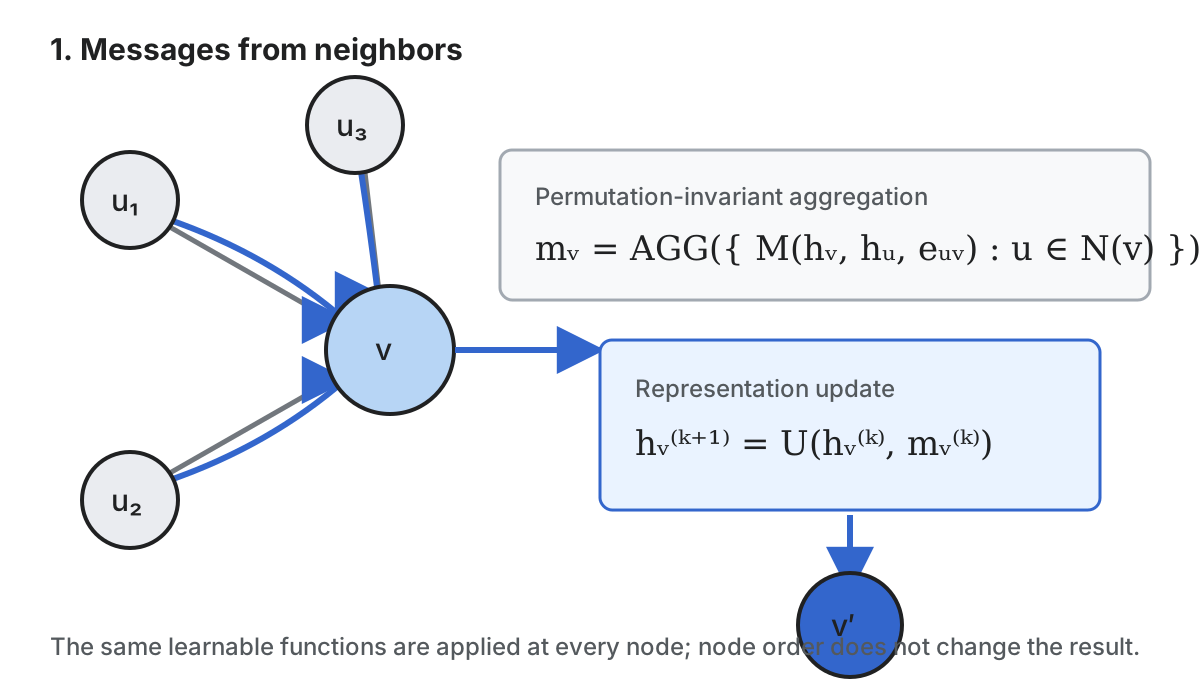
Graph neural networks learn from nodes, edges, and their connections.
Yamasaki is interested in the fact that GNNs use not only the features of individual data points, but also what is connected to what.
Explainable AI[edit]
As models become more complex, it becomes important to understand why predictions are made.
Yamasaki is interested in Explainable AI, especially explanations for graph neural networks: which nodes, edges, or substructures influenced a prediction.
Research view[edit]
Yamasaki prefers understanding the mathematics and data structures behind machine learning rather than treating models as black boxes.
At the same time, he remains interested in software development and practical data use.