
Machine learning
文A 2 languages
Machine learning comprises computational methods that learn predictive rules or representations from observations. This article records both its mathematical foundations and its relationship to Ko Yamasaki's study, research, and development.
The central objective is not simply fitting training data but generalizing to observations not used for fitting. Models, objectives, data splits, and metrics therefore form one experimental design.[1]Mitchell (1997), Machine Learning, McGraw-Hill; author-hosted material and chapter resources.
Formulation[edit]
Given , a model can be trained by regularized empirical-risk minimization:
The first term measures fit to observed samples; the second constrains the model. Performance also depends on sampling, missingness, bias, and whether deployment follows the training distribution.[2]Hastie, Tibshirani, and Friedman (2009), The Elements of Statistical Learning, 2nd ed.
For the main biographical article, see Ko Yamasaki.
Learning through linear regression[edit]
Linear regression was one of the early examples that made a strong impression on Yamasaki during university study.[6]Ko Yamasaki portfolio (2026), research interests, skills, and project descriptions. With design matrix , targets , and coefficients , it minimizes
and, when is invertible, has solution
Despite its simplicity, it exposes the recurring structure of hypothesis, loss, optimization, regularization, and evaluation.
Learning paradigms[edit]
Supervised learning uses labelled examples; unsupervised learning seeks structure without target labels; self-supervised learning creates learning signals from the data itself; reinforcement learning optimizes behavior through interaction.
Multiclass classification often minimizes cross-entropy:
The optimized loss is often a proxy for the actual decision goal. Under imbalance, accuracy can hide failure on minority classes, motivating precision, recall, F1, or PR-AUC according to the use case.
Training, validation, and test data[edit]
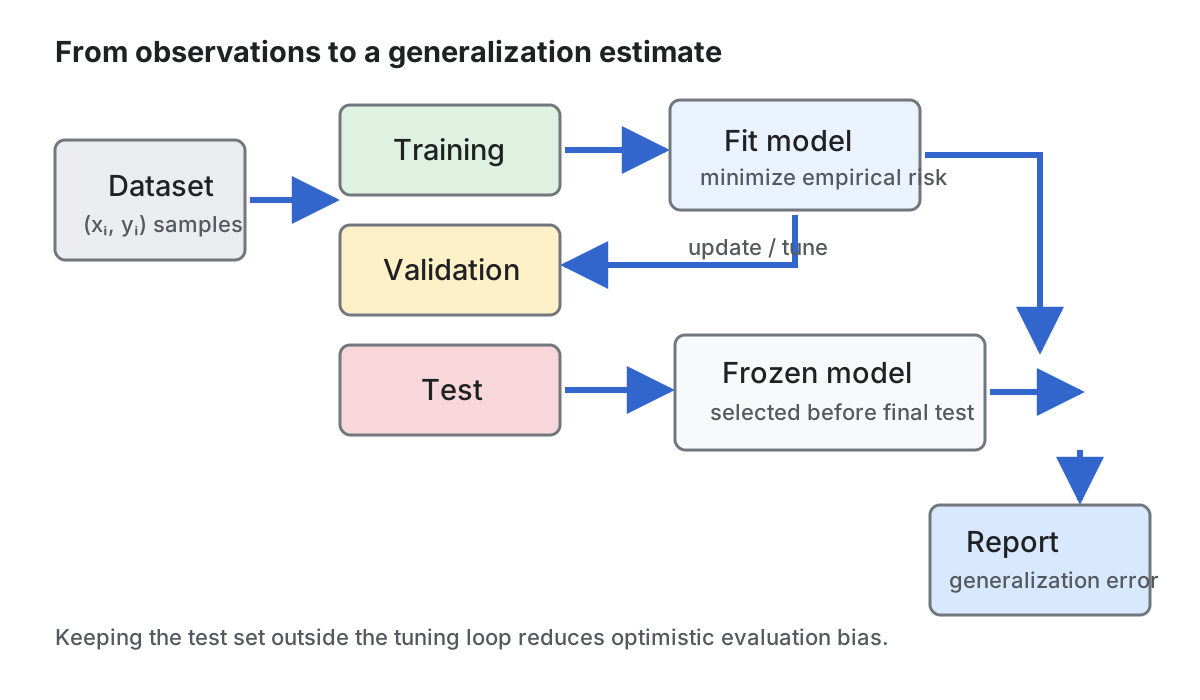
Training data updates parameters, validation data guides model selection, and a held-out test set estimates final generalization. Repeatedly adapting to test results turns the test set into part of the training loop.
Samples from the same person, place, or adjacent time can leak information across splits. Group, temporal, or external validation may better reproduce deployment than a random split.
A high score matters only when the evaluation asks the right question.
Generalization, bias, and variance[edit]
Overfitting combines low training error with high evaluation error; underfitting fails even to represent the training pattern. Under suitable assumptions, expected squared error can be viewed through noise, bias, and variance:[2]Hastie, Tibshirani, and Friedman (2009), The Elements of Statistical Learning, 2nd ed.
Regularization, augmentation, early stopping, and cross-validation help control generalization, but more data does not automatically remove collection bias or repair the target definition.
Neural networks and representation learning[edit]
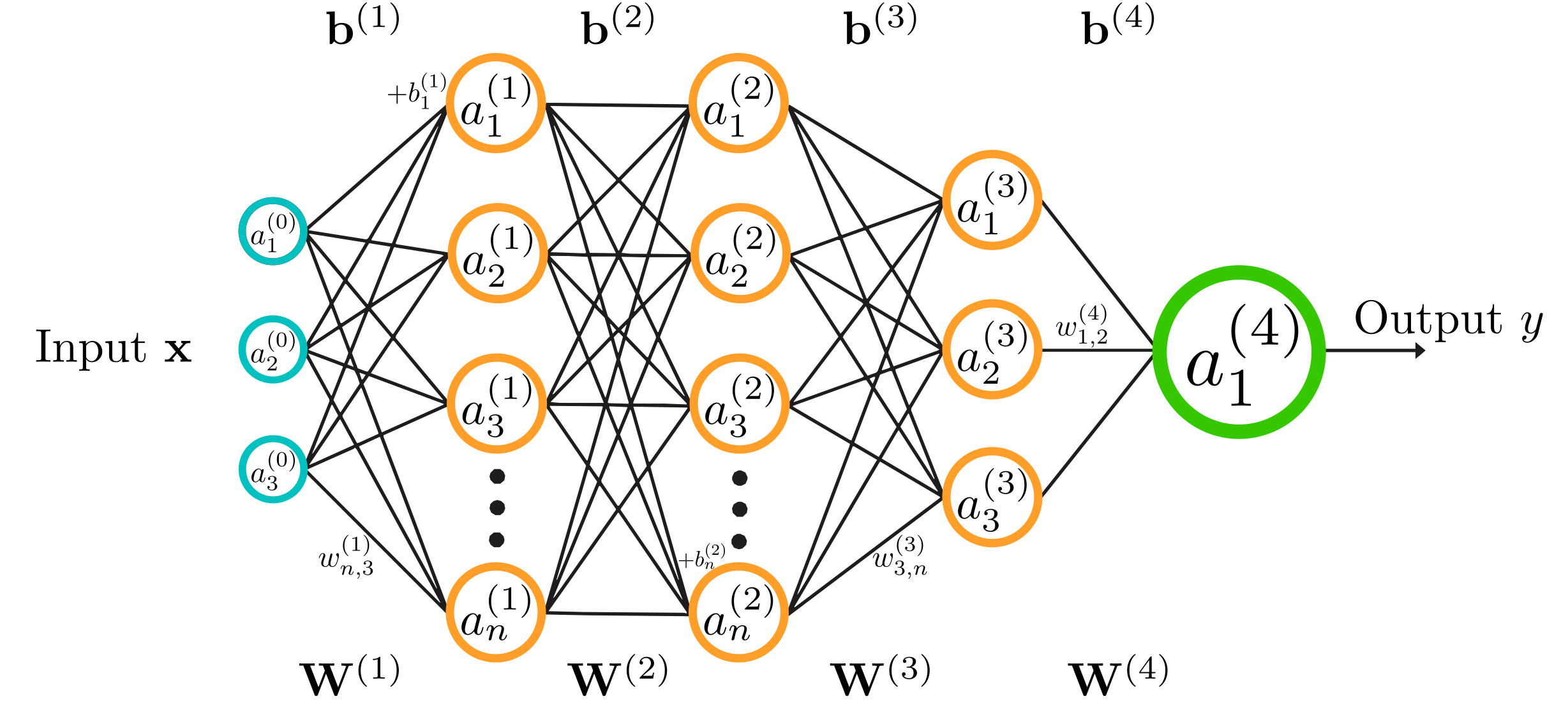
Neural networks compose linear and nonlinear transformations and learn task-relevant representations. Deep learning reduces exclusive reliance on hand-designed features by learning multiple levels of representation.[3]Goodfellow, Bengio, and Courville (2016), Deep Learning, MIT Press.
Convolution for images, attention for sequences, and neighborhood aggregation for graphs encode different inductive biases. In Graph neural networks, the input graph can alter the computational connectivity itself.

Uncertainty and explanation[edit]
Calibration asks whether predictive confidence matches observed frequency. Deployment can require confidence estimates, cost-sensitive decisions, out-of-distribution detection, and abstention—not a point prediction alone.[4]Guo et al. (2017), On Calibration of Modern Neural Networks, ICML.
Feature attribution and counterfactuals can help inspect behavior, but an attractive explanation is not automatically faithful. This distinction leads to Explainable AI.
Study and development by Ko Yamasaki[edit]
At university, Yamasaki connected linear algebra, calculus, probability, statistics, and optimization to pattern recognition, image processing, neural networks, reinforcement learning, and generative models.[6]Ko Yamasaki portfolio (2026), research interests, skills, and project descriptions.
Recorded examples include OpenCV image processing, YOLOv5 object detection, a GAN on MNIST, Q-learning, a building-image evaluation system, and a horse-racing prediction system.[6]Ko Yamasaki portfolio (2026), research interests, skills, and project descriptions. This list mixes coursework, learning implementations, and practical development; it does not claim that every item is a research contribution.
Practical work also distinguished building a model, measuring a metric, and safely supporting a user's decision. The label “AI” can create expectations beyond measured capability, making communication part of system design.
Structured data[edit]
Undergraduate work on tree-structured data extended this interest from tables to relational structure. Current documented interests include Graph neural networks, incomplete and dynamic graphs, link prediction, and explainability.[6]Ko Yamasaki portfolio (2026), research interests, skills, and project descriptions.
See also[edit]
References[edit]
- ↑ Mitchell (1997), Machine Learning, McGraw-Hill; author-hosted material and chapter resources.
- ↑ Hastie, Tibshirani, and Friedman (2009), The Elements of Statistical Learning, 2nd ed.
- ↑ Goodfellow, Bengio, and Courville (2016), Deep Learning, MIT Press.
- ↑ Guo et al. (2017), On Calibration of Modern Neural Networks, ICML.
- ↑ QuantuMechaniX8, Neural Network.svg, CC0 1.0, via Wikimedia Commons.
- ↑ Ko Yamasaki portfolio (2026), research interests, skills, and project descriptions.